|
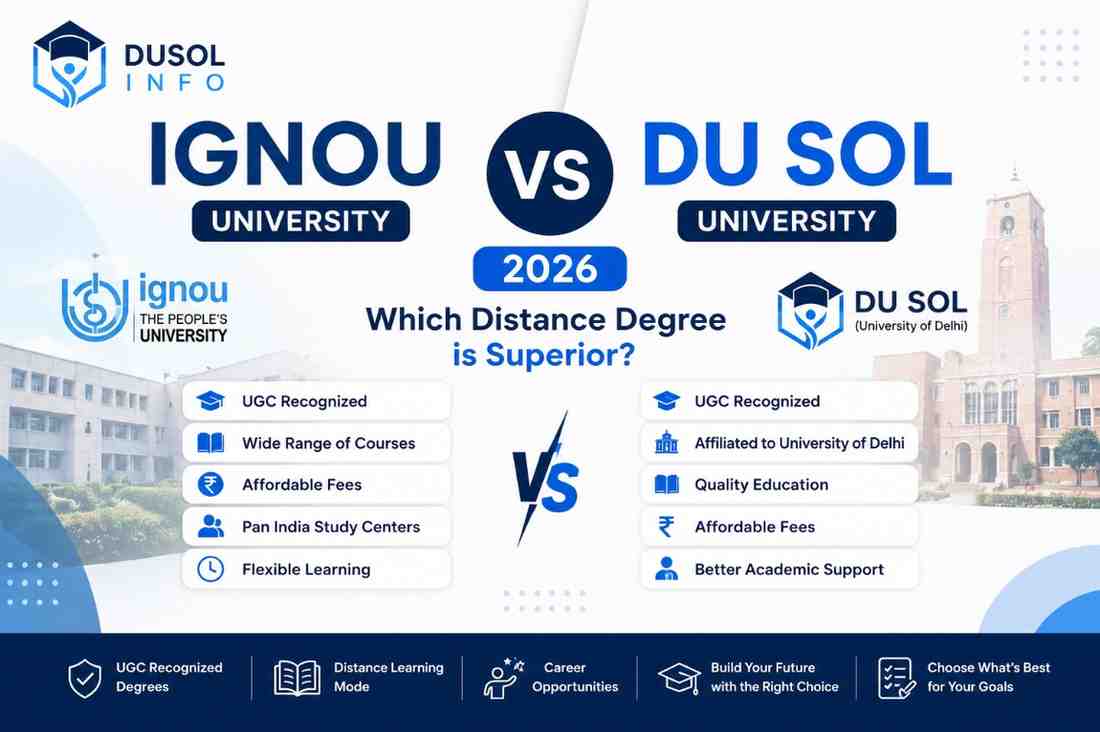
Comparative Summary: IGNOU vs DU SOL IGNOU: 1985 origin, all of India reach, extensive subject selection DU SOL:1962 origin, Delhi University endorsement, Delhi focus Both: Approved by UGC-DEB, credentialed for government positions, UPSC, postgraduate studies Examination: IGNOU 2 annually (June and December); DU SOL 1 annually (May-June) Optimal choice: Factor in location, finances, and subject selection to decide |
Every year, IGNOU vs DU SOL comparisons are searched by hundreds of thousands of students across India. Both universities offer distance learning degrees that are government-recognized, UGC-DEB accredited, and allow graduates to qualify for government jobs, competitive exams, and postgraduate study. However, they also differ on three major fronts: fees, flexibility, and employer perception.
This guide breaks down IGNOU vs DU SOL across recognition, fees, exam patterns, study material, flexibility, and career opportunities, so you can make a properly informed decision beyond the common opinions floating around online.
Read More:DU SOL BA Course Subjects 2026
What Is IGNOU?
India's largest distance learning university, Indira Gandhi National Open University (IGNOU), was founded in 1985 to offer distance education across the Indian subcontinent in a more inclusive manner and provide accessible education to a greater number of students.
The School of Open Learning (SOL) at Delhi University (DU), on the other hand, was founded in 1962 to cater to students who wished to earn a Delhi University degree while employed or unable to attend regular college. As part of Delhi University, DU SOL provides degrees that carry the same value as degrees from DU's regular colleges.
IGNOU and DU SOL Head-to-Head
|
Factor |
IGNOU |
DU SOL |
|
Inception Year |
1985 |
1962 |
|
Geographic Presence |
Every state and union territory of India, plus select international study centres |
Primarily within the National Capital Territory (Delhi) |
|
Variety of Courses |
Broad range across disciplines at UG, PG, diploma, and certificate levels |
Limited courses, mainly at UG and PG levels |
|
Cost of Course |
Generally lower — ₹7,000-15,000 range for most Bachelor's degrees |
Higher base fee, but many charges are bundled in |
|
Exam Format |
Term-End Exams (TEE) twice yearly, for the June and December sessions |
Annual exams, typically in the May-June session |
|
Assignment Weightage |
Generally 30% of total marks |
Generally 25% of total marks |
|
Study Material |
Printed books, e-books, and video lectures, available at study centres or delivered by post |
Digital and/or printed material; some materials collected from designated post offices |
|
Value of Degree |
Recognised nationally as India's largest open university |
Delhi-based, but well respected due to direct Delhi University affiliation |
Recognition: Are Both Degrees Equal?
Yes. Degrees from both DU SOL and IGNOU are eligible for government exams such as UPSC, SSC, and banking exams. They are also accepted for private sector employment and for further education, postgraduate and beyond, in India and abroad.
That said, "equal recognition" does have a subjective side. DU SOL derives an edge from its parent institution, Delhi University, which carries substantial reputation, especially for students who will remain in Delhi or want to use DU's alumni network. IGNOU, meanwhile, has extensive, well-earned recognition in India and abroad as a large and established open university.
|
Important Consideration Recognition shouldn't be your only deciding factor. Some employers and institutions may have preferences based on their own experience with graduates from either university. If you have a particular industry or a subsequent course in mind, it's worth assessing how that field perceives distance-mode degrees from IGNOU versus DU SOL before making your decision. |
Fees: Which One Is More Affordable?
On fees, IGNOU is almost always the more affordable option. Most Bachelor's programmes at IGNOU cost between ₹7,000 and ₹15,000, collected yearly, so there's no large upfront burden. However, students should set aside additional funds for exam fees, project fees, and other administrative charges, since these are rarely included in the base tuition.
DU SOL has a higher base tuition fee, but many exam-related costs are already included in it, making the total more predictable upfront. DU SOL students from outside Delhi should be prepared for added indirect costs over the course of their degree — travel to Delhi for exams, possible stays, and material collection from designated centres.
Exam Structure & Relative Difficulty
IGNOU's Term-End Exam (TEE) is held twice yearly, in June and December. Assignments carry about 30% weightage toward the final marks, meaning weaker exam performance can be partly offset by strong assignment scores. Students can also attempt backlog papers multiple times, which adds meaningful flexibility to the system.
DU SOL, in contrast, conducts annual exams in the May-June period, with assignments contributing about 25% to the final marks. Because it's an annual system, one underperforming exam can set a student back by a full year, making it more rigid compared to IGNOU's twice-yearly structure. DU SOL's syllabus is also generally considered more demanding, given its direct affiliation with Delhi University's regular colleges.
Study Material & Learning Support
IGNOU's established resource system provides printed books, e-books, and video lectures, with study centres set up across major cities in India, making the system fairly accessible. DU SOL has also modernised by offering online classes and study material with recorded and live lectures, though students still need to collect some printed materials from post offices, and its support infrastructure remains more concentrated within Delhi.
|
Pro Tip List your deal-breakers — location, budget, course variety, and how much flexibility you genuinely need — before deciding. A student living in Delhi who wants the DU brand will likely find SOL a good fit. A student living in another state who wants flexibility and course variety will probably find IGNOU the better option. Prioritize your own situation over a generic "which is better" answer. |
Location & Flexibility
This is often the biggest factor in the decision. All study centres, exam centres, and assignment submission points for DU SOL are located in Delhi. If you live outside Delhi, you'll need to travel there periodically for exams and, in some cases, practical assessments — a real time and financial burden over several years of study.
IGNOU, by comparison, offers considerably more flexibility, with a choice of study centres, exam centres, and assignment submission locations across India. This makes it a better fit for working professionals, students who relocate frequently, or those living outside Delhi who want a recognised distance-mode degree without the added travel burden.
Course Variety
IGNOU offers a broader selection of courses at UG, PG, diploma, and certificate levels, spanning arts, science, technology, management, and even niche vocational fields such as Disaster Management, Cyber Law, Tourism, and Dairy Technology.
DU SOL's course catalogue is comparatively narrower, focusing mainly on popular undergraduate and postgraduate programmes. If your interest lies in a specialised or vocational field, IGNOU is more likely to have a dedicated programme for it.
Career Scope & Placement Support
Degrees from both universities are valid for higher studies and for government and private sector jobs in India and abroad. Graduates from both IGNOU and DU SOL have gone on to pursue postgraduate degrees such as MBA, MA, and M.Com at reputed institutions.
DU SOL has improved its placement services and career counselling through a dedicated cell, which is a genuine advantage for students living in and around Delhi who want structured career support alongside their degree. IGNOU also offers career counselling and some placement assistance, though given the university's scale, support tends to vary more by region and study centre.
|
Bottom Line Neither university is universally better — the right choice depends on where you live, how much you're willing to pay, and where your desired courses are offered. Delhi-based professionals who want the DU brand typically lean toward SOL, while those who want more course flexibility and nationwide options usually lean toward IGNOU. |
Admission Process: IGNOU vs DU SOL
Both universities use a largely online admission process, but there are some practical differences worth knowing before you apply:
- IGNOU: Applications open in January and July for the respective study sessions. There is no entrance exam for most undergraduate courses. The process requires applicants to register, upload the required documents, and pay the application fee through the official IGNOU portal.
- DU SOL: Admissions open once a year for the main academic cycle, with separate cycles for certain postgraduate and professional courses. There is no entrance exam for most undergraduate courses. The process requires registration and document verification through the official SOL admission portal.
Both universities occasionally announce special or extended admission periods, so check their official websites — ignou.ac.in and sol.du.ac.in — for the most accurate information rather than relying on the previous cycle's dates.
Read Also:DU SOL Results 2026
Which University Should You Choose? Checklist
Use these quick pointers to pick the university that best matches your situation:
Choose DU SOL if:
- You reside in Delhi or the NCR and can attend exams in person without major difficulty.
- You want the Delhi University brand and its alumni network.
- Your desired course — such as BA, B.Com, or BBA — is available at DU SOL, and you plan to remain in Delhi throughout your studies.
Choose IGNOU if:
- You live outside Delhi or may need to relocate during your studies.
- You want the flexibility to change your exam or study centre as your circumstances change.
- You want more course options, including specialised diplomas or vocational programmes.
- You're balancing a career and need a more flexible, self-directed learning structure.
There is no single "right" answer here — both are reputable, UGC-recognised universities that help thousands of students complete their degrees while balancing employment, family, and other commitments. The right answer is simply the one that best serves your specific needs.
Frequently Asked Questions
Q1. Are a DU SOL and IGNOU degree the same in value?
Yes. Both degrees are UGC-DEB approved and recognised for government employment, competitive exams, and postgraduate studies. Neither holds a legally higher standing than the other.
Q2. Which one is more affordable, IGNOU or DU SOL?
IGNOU generally has a more affordable base tuition cost, though students must pay separately for exam and administrative fees. DU SOL has a higher base cost, but more charges are bundled into it upfront.
Q3. Which is better for students outside Delhi?
IGNOU is generally the better option for students outside Delhi, since it has study, exam, and assignment submission centres spread across India.
Q4. Can I pursue an MBA or M.Tech after completing my degree from IGNOU or DU SOL?
Yes. Degrees from both universities are accepted for higher studies, including professional postgraduate degrees, in India and abroad.
Q5. Which university has tougher exams?
DU SOL's exams are generally considered tougher, mainly because they closely follow the regular DU academic schedule with an annual format, whereas IGNOU's extensive self-study requirement poses a different kind of challenge.
Q6. Which is better for working professionals?
IGNOU is generally considered more favourable for working professionals, due to its self-paced learning structure, flexible exam schedules, and wider choice of study centres.
Conclusion
Ultimately, the choice between IGNOU and DU SOL depends on what you value more — location, budget, course availability, or brand reputation. For students outside Delhi, or those who need more self-paced study, IGNOU's course variety and lower fees make it the stronger option. DU SOL offers the Delhi University name along with increasingly strong academic and placement support. Weigh both against your own priorities and goals. For more comparisons, admission guidance, and updates on DU SOL, keep visiting dusolinfo.in