



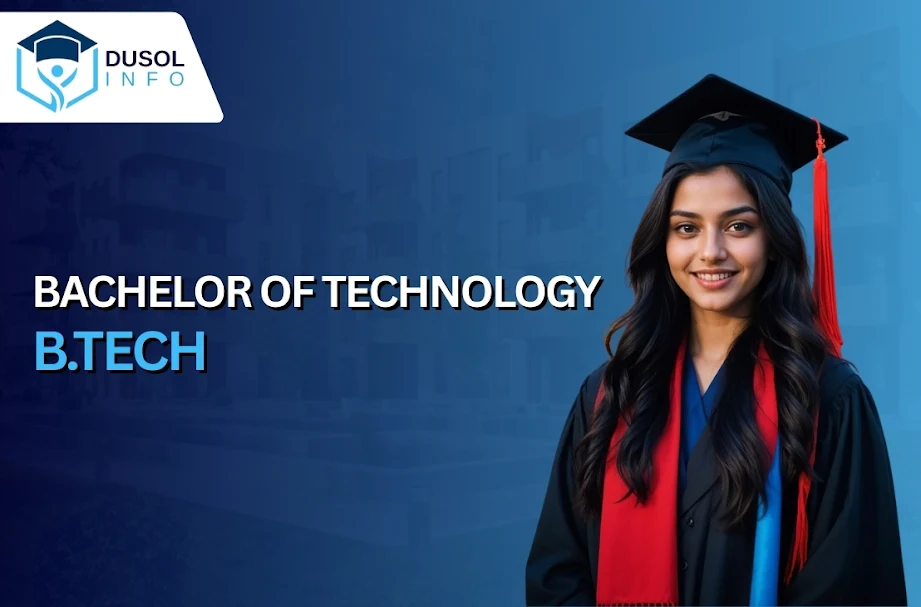
Bachelors of technology (B.Tech) is a four years undergraduate programme designed for students who wish to build a career in engineering, technology, research, software development, infrastructure, manufacturing and other. The course is aimed at providing technical knowledge and practical skills as well as the ability to solve problems and understand engineering concepts. B.Tech generally involves the study of both theory, practicals, projects, industrial training and skill development. Students are allowed to study various disciplines of engineering and technology as per the specialization chosen by them. The university offers the course in various specializations such as computer science and engineering, Mechanical Engineering, Civil engineering, electrical engineering, electronics and communication engineering and information technology. The university has designed the course in a way that it not only develops technical ability but also the innovation capacity, research capability and leadership skills among others. This can allow students to get into professional fields of engineering, IT, manufacturing, construction, research and technology based industries. Interested students who are seeking admission to the B.Tech course a DU SOL must need to satisfy the eligibility criteria. The requirements include 10+2 certificate in science with mathematics stream. Students also need to secure a minimum of 45% of marks. After completing the course students can explore their career in engineering, software and IT, manufacturing, construction, electronics, research, technology management and other technical sectors. Students can also pursue further studies in M.Tech, MBA, MS and more.
NOTE: B.Tech programme at DU SOL is not offered in online and distance learning. Students need to pursue the course in regular mode of education only as per AICTE approval.
Students who are seeking to study undergraduate program in engineering and technology must have the learning objective for the program B.Tech. This program aims at offering students technical knowledge, practical exposure, engineering principles and problem solving skills.
Below is the some of the important learning objective are given below:
Students desirous of getting admission into B.Tech programs need to be aware of the eligibility norms set by the DU SOL. General eligibility norms that need to be satisfied in order to get admission into B.Tech program are as follows:
|
Major Areas |
What students will study |
|
Engineering Mathematics |
Mathematical concepts, calculus, algebra, statistics and numerical methods used in engineering. |
|
Physics & Chemistry for Engineers |
Fundamental concepts of physics and chemistry and their applications in engineering and technology |
|
Mechanics & Thermodynamics |
Mechanics, energy, heat, thermodynamic systems and their engineering applications. |
|
Basic Electrical Engineering |
Electrical circuits, systems, components and fundamental electrical concepts. |
|
Basic Electronics Engineering |
Electronic components, circuits, digital systems and basic electronic technologies. |
|
Basic Computer Engineering |
Computer fundamentals, computing concepts, hardware, software and basic programming. |
A B.Tech degree can open career opportunities across engineering, technology and other technical sectors. Career options may depend on the students specialization, technical skills, practical experience and more. Below is the various career options available for students:
Students who want to gain advanced knowledge can pursue higher studies in M.tech, M.E., MBA, MS, and more.
Q) How long does the B.Tech course take?
B.Tech programmes generally have a duration of 4 years divided into 8 semesters. Students will study core engineering subjects along with specialization specific courses, practical work and projects.
Q) What is the eligibility criteria for a B.Tech course?
Generally, the eligibility criterion for B.Tech is 10+2 with Physics, Chemistry, Mathematics. Normally, students are required to have around 45%-50% aggregate marks.
Q) Is Mathematics a must for B.Tech?
Yes. Mathematics is generally considered an important eligibility subject for B.Tech due to its involvement in engineering courses. Normally, students need to have Physics, Chemistry and Mathematics in their 10+2 examination.
Q) What are the different branches in B.Tech?
B.Tech can generally be provided in various engineering branches in accordance with various institutions. Some of the common branches are Computer Science & Engineering, Mechanical Engineering, Civil Engineering, Electrical Engineering, Electronics and Communications Engineering and Information Technology.
Q) What are the options for students after B.Tech?
There are many options after B.Tech, some of which include careers in the field of engineering, IT, software, manufacturing, construction, electronics, research and technology services, and others. Students can also opt for higher education in M.Tech, M.E., MBA, MS, or PhD.
Q) Can B.Tech graduates pursue their MBA?
Yes. If B.Tech graduates meet the eligibility criteria of the respective college, then they can pursue an MBA. MBA can lead B.Tech graduates into the world of business management and operations.
Q) Is B.Tech helpful in IT career?
Yes. Streams like Computer Science and Engineering and Information Technology can be very helpful in pursuing a career in IT.