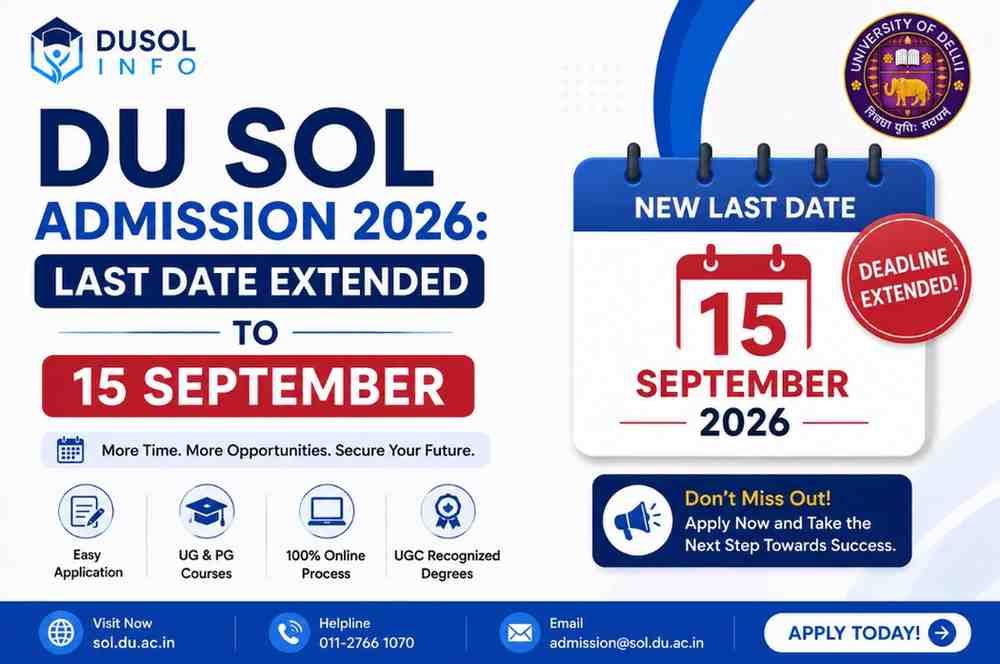
Good news for those who thought they had missed out on applying to DU SOL for 2026-27 — the last date has been extended, and admissions for UG, PG, and skill courses are still open. This guide gives you the updated deadline, eligibility criteria, popular courses, fees, and the full application process before the window closes.
Quick Reference: DU SOL Admission 2026
At a Glance
- Admission status: Live and confirmed for UG and PG, 2026-27 session, on the official SOL website
- New extended last date: 15 September 2026 (always confirm on sol.du.ac.in)
- Application portals: ugadmission.oldcdu.ac.in (UG); pgadmission.oldcdu.ac.in (PG)
- Application fee: ₹500 (General/OBC-NCL/EWS); ₹250–300 (SC/ST/PwBD)
- Admission basis: Merit-based for UG and MBA; CUET PG for most other PG courses (unless you're a DU graduate)
- New for 2026-27: B.Sc (Hons) Computer Science and MBA (Executive) Healthcare Administration, both newly added this cycle
Read also :Delhi University Degree Certificate for DU SOL Students
Why the DU SOL Admission Deadline Changes So Often
If you've been actively monitoring DU SOL admission dates for 2026-27, the shifting deadlines won't be a surprise. There have been multiple changes this cycle — from June 30 without a late fee, to July 31 with a late fee, and now extending further to September for several programmes. DU SOL regularly pushes deadlines to accommodate ongoing demand, especially for newer and popular postgraduate courses.
Currently, the official SOL website shows admissions for both UG and PG courses as "LIVE," confirming they are still open. That said, since exact cutoff dates have varied across programmes and sources this cycle, treat any date in this guide — or any other guide — as tentative until you confirm it on the "All Notices" section of sol.du.ac.in, which is where official extensions are announced as they happen.
DU SOL Courses Open for Admission 2026-27
|
Level |
Programmes Open for Admission |
|
Undergraduate |
B.Sc (Hons) Computer Science, BMS, BBA (FIA), B.A. (Hons.) English/Political Science/Economics, B.Com (Hons.), B.Com, B.A. Programme (Computer Applications, Economics, Education, English, Hindi, History, Mathematics, Political Science, Sanskrit, Urdu) |
|
Postgraduate |
MBA, MBA (Executive) Healthcare Administration, M.A. (Hindi, Sanskrit, History, Political Science), M.Com., BLISc, MLISc, PGDADLM |
|
Skill & Certificate Courses |
A wide range of job-ready skill courses and foreign language certificate/diploma courses, also currently open |
Two programmes are brand new to this admission cycle: B.Sc (Hons) Computer Science at the UG level, and MBA (Executive) Healthcare Administration at the PG level — both worth a closer look if you're interested in tech or healthcare management respectively.
Spotlight: The Two New DU SOL Programmes for 2026-27
B.Sc (Hons) Computer Science is a new offering from DU SOL at the undergraduate level — a dedicated science-stream degree in computing and technology. Previously, DU SOL's computing-related courses were embedded within arts-based degree programmes. This new programme follows DU SOL's standard 3-year, 6-semester UG structure, with eligibility expected to be similar to other science programmes: a Class 12 pass, generally from the science stream, meeting the qualifying percentage.
MBA (Executive) Healthcare Administration caters to those already working, or wishing to move into, healthcare administration — such as hospital administrators and healthcare managers. As an executive programme, it's designed for working professionals rather than fresh graduates, so its eligibility and admission process differ from the standard MBA and are detailed in a separate dedicated prospectus.
Since both programmes are new, some details may still be getting finalised — always refer to the specific prospectus PDF for whichever one interests you, rather than assuming it follows the exact same structure as DU SOL's older, established courses.
People also read:DU SOL BA Admission 2026
Eligibility Criteria for DU SOL Admission 2026
- UG programmes: A pass in Class 12 (10+2) from a recognised board, with the required qualifying percentage varying by programme.
- PG programmes (M.A., M.Com): A bachelor's degree from a recognised university, along with a valid CUET PG score for the current cycle, unless you graduated from DU itself.
- MBA: A bachelor's degree with a minimum of 50% marks; admission is merit-based on graduation performance, not through CUET PG.
- MBA (Executive) Healthcare Administration: Aimed at working professionals from the healthcare sector, with its own specific eligibility criteria detailed in its dedicated prospectus.
DU SOL Fee Structure 2026 (Approximate)
- Application fee: ₹500 for General/OBC-NCL/EWS; ₹250–300 for SC/ST/PwBD
- UG programme fees: Approximately ₹8,870–₹22,520 per year, depending on the course
- MBA annual fee: Approximately ₹52,570
These figures are approximate and subject to change by programme and category — confirm the exact fee on the official prospectus for your chosen course before applying.
What You'll Need to Apply
- Class 10 and Class 12 mark sheets and certificates (for UG applicants)
- Graduation mark sheets and degree certificate (for PG applicants)
- CUET PG scorecard (where applicable for PG courses)
- A recent passport-size photograph and scanned signature
- A valid government ID proof
- Category certificate, if applying under a reserved category
- Employment or experience certificates (for MBA Executive Healthcare Administration applicants, as per the prospectus)
Step-by-Step: How to Apply for DU SOL Admission 2026
- Step 1 — Select your level: Decide between UG and PG, as each uses a separate application portal.
- Step 2 — Use the right portal: ugadmission.oldcdu.ac.in for UG courses; pgadmission.oldcdu.ac.in for PG courses.
- Step 3 — Create an account: Register with your mobile number and email address.
- Step 4 — Enter your academics: For UG, add your Class 12 marks. For most PG courses, add your graduation marks and CUET PG score.
- Step 5 — Choose your course: Select your programme and specialization where applicable.
- Step 6 — Upload documents: Upload your mark sheets, photograph, signature, ID proof, and category certificate (if required).
- Step 7 — Pay the application fee: Complete payment as per your category.
- Step 8 — Track your application: Monitor your status through the student dashboard for verification updates.
UG vs PG Admission: Key Differences
Since UG and PG admissions run through separate portals and processes, here are the important practical differences:
For UG admissions, there's no entrance exam — selection is based entirely on Class 12 marks. You register, enter your marks, upload documents, and the admission committee assesses eligibility. For most PG admissions (excluding MBA), a valid CUET PG score from the current cycle is required, and DU SOL doesn't conduct its own separate entrance exam — so non-DU graduates need to have already appeared for CUET PG before applying. MBA is the exception: like UG, it's merit-based, but on graduation marks rather than a CUET score.
This distinction matters most for students hoping to join M.A. or M.Com this year without a CUET PG score — for most non-DU graduates, a valid CUET PG score is mandatory, regardless of how strong their academic record is.
Why You Shouldn't Delay Applying
Even with an extended window, there are practical reasons to apply as soon as possible. Portal traffic spikes sharply near any deadline, which can cause slowdowns right when you need the site to work smoothly. Document verification also takes time, and applying early gives you a buffer to resolve issues — like an unclear scan or a name mismatch — without risking the final cutoff. Given that DU SOL's admission dates have already shifted multiple times this cycle, there's no guarantee of another extension once the current deadline passes.
Common Mistake to Avoid
Don't rely on a single deadline figure from any one source — including third-party guides — since DU SOL's last date has genuinely shifted multiple times this cycle for different programmes. The only place to trust for confirmed, official updates is the "All Notices" section on sol.du.ac.in, where extensions are announced as they happen.
Pro Tip
For the newly introduced programmes — B.Sc (Hons) Computer Science and MBA (Executive) Healthcare Administration — download and read the specific prospectus PDF for that programme rather than relying on general DU SOL information, since new programmes often have eligibility or documentation requirements that differ slightly from the older, more established courses.
Read more:BBA Degree Course 2026
Frequently Asked Questions
Q1. What is the last date for DU SOL admission 2026?
Based on the most recent available information, the last date has been extended to 15 September 2026 for several programmes. Always confirm the current date on sol.du.ac.in before finalising your plans.
Q2. Is DU SOL admission still open right now?
Yes. The official SOL website currently shows UG and PG admissions for the 2026-27 session as live and active.
Q3. Is CUET mandatory for DU SOL admission?
It depends on the programme. Most UG courses and the MBA are merit-based with no CUET requirement. Most other PG courses like M.A. and M.Com require a valid CUET PG score, unless you're a DU graduate.
Q4. What new courses has DU SOL added for the 2026-27 session?
DU SOL has added B.Sc (Hons) Computer Science at the UG level and MBA (Executive) Healthcare Administration at the PG level, both newly introduced this admission cycle.
Q5. Where do I apply for DU SOL admission 2026?
UG applications go through ugadmission.oldcdu.ac.in and PG applications through pgadmission.oldcdu.ac.in, both accessible from the official sol.du.ac.in website.
Q6. Is a CUET PG score required for the MBA (Executive) Healthcare Administration programme?
No. Like the regular DU SOL MBA, this programme is merit-based and doesn't require CUET PG, though it has its own eligibility criteria for working professionals detailed in its dedicated prospectus.
Q7. What happens if I miss this extended deadline?
For most DU SOL programmes, the main admission cycle happens annually, so missing an extended deadline typically means waiting for the next academic session. Occasional special or late admission windows can sometimes open for specific courses — always check the official notices page for updates.
Conclusion
DU SOL admissions for 2026-27 are still active and extended — but given how many times the deadlines have already shifted this cycle, it's worth submitting your application as soon as possible rather than waiting for the extension to run out. Keep your documents ready and apply through the correct UG or PG portal. For the latest updates on DU SOL admissions, courses, and deadlines, keep following dusolinfo.in