|
Application Overview for the DU SOL Provisional Certificate Application Website: exam.du.ac.in Price: ₹500 (per copy) Issuance: 10 days (after document verification) Requirements: Enrolment number, marksheet, photograph, signature (scanned) Validity: Until original degree is issued |
You've just completed your last semester at the School of Open Learning and need to show proof of graduation before your degree certificate arrives — don't worry, that's exactly what the DU SOL Provisional Certificate is for. This document may be the least explained part of the entire DU SOL process, yet it's one that the majority of students will eventually need.
Here, I'll walk you through what the provisional certificate is, why it's necessary, the process of getting it, the documents required, how long it takes, and the common issues I've noticed students run into while obtaining it.
Read Also:DU SOL Fee Payment Online
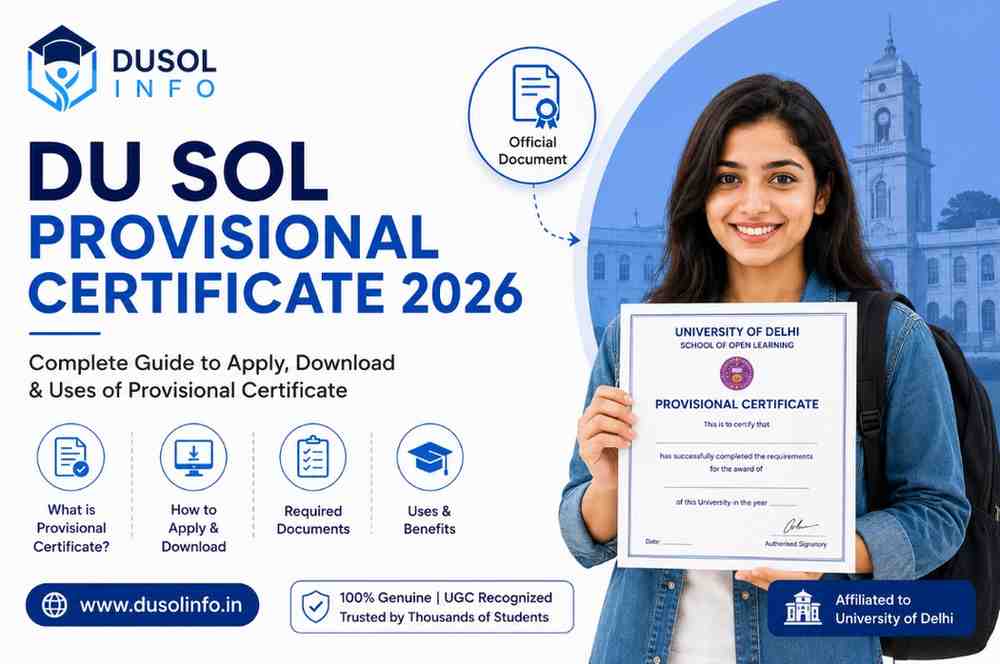
What Is a Provisional Certificate?
A provisional certificate serves as a temporary substitute for your degree. Once you've completed your degree requirements, you generally have to wait for your degree to be printed and presented at a formal ceremony (convocation) before the university makes an official statement about your degree. In the meantime, you can treat your provisional certificate as your degree for almost every practical purpose.
Convocations aren't held for every batch every year, and can sometimes be delayed by years. During that gap, your provisional certificate serves the purpose of your degree for employment, further education, and eligibility for government examinations.
Why Is It So Important for DU SOL Students?
Many graduates of the School of Open Learning (SOL) at Delhi University (DU) never attend a formal convocation to collect their degree. Since convocations aren't mandatory, most distance-learning students end up skipping them altogether. For SOL graduates, the provisional certificate ends up being the primary proof of graduation for employment and further studies for years, not just a few months.
This matters a lot if you're applying for exams like UPSC, SSC, banking exams, or even a postgraduate degree where you need to present your undergraduate degree at the time of application. In most cases, the provisional certificate or the final year marksheet is accepted as proof of graduation at the application stage, with the original degree required later during document verification.
|
Important Note The provisional certificate isn't meant to be your proof of graduation forever — it's meant to be replaced once your original degree is issued. Don't assume you're done just because you have the provisional copy in hand. It's your responsibility to check whether your original degree has been issued, especially if you're planning to apply abroad or need a notarized document, since some organisations specifically require the original. |
When Can You Apply?
You can apply for your provisional certificate as soon as your final semester or final year results are declared and you've passed all the required papers. You don't have to wait for convocation, and you don't need to wait for your original degree process to begin either — the provisional certificate application is entirely independent of that timeline.
Step-by-Step: How to Apply for the DU SOL Provisional Certificate
The whole process is online and handled through the University of Delhi's examination portal. Here's how it works:
Step 1: Go to exam.du.ac.in and look for the Provisional Certificate section under Services.
Step 2: Register and complete the online application form. Keep your University Enrolment Number ready, since the form won't let you proceed without it.
Step 3: Attach a scanned copy of your passport-size photo and signature.
Step 4: Attach a scanned copy of your final year marksheet or result.
Step 5: Pay the non-refundable fee of ₹500 per copy through the online payment facility. If you anticipate needing multiple copies for different job applications or institutions, it's worth paying for more than one copy now, since re-applying later means paying the fee again.
Step 6: You'll receive an acknowledgement receipt along with a receipt number. Keep this safe, since you'll need it to track your application status.
|
Pro Tip Before you even open the application form, get your scanned photo, signature, and marksheet organised in a single folder on your computer. Students often run into delays simply because a scan was in the wrong file format or too large in size. Getting this sorted beforehand saves you the long process of re-uploading and re-verifying documents later. |
Required Documents
- University Enrolment Number
- Recent passport-size photograph (scanned)
- Scanned signature
- Scanned final year marksheet or result
- Access to a valid online payment method
Keep physical or clearly saved digital copies of these documents on hand even after submission, since you may occasionally be asked to email supporting documents to resolve a verification issue.
How Long Does It Take?
The provisional certificate is typically issued within 10 days of submitting your application and having your documents verified. That said, issuance can be delayed during peak periods — right after result declarations, when large numbers of students apply at once — so it's best to apply as soon as you're eligible rather than waiting.
If you don't receive an acknowledgement after submitting your application, email the relevant examination branch with a copy of your application, fee receipt, and uploaded documents. This helps ensure there's a record confirming you applied on time.
Where to Submit Based on Your Enrolment Number
Delhi University processes provisional certificate applications through different offices depending on where your enrolment number originates:
- North Campus enrolment numbers: Academic Branch-II, North Campus
- South Campus enrolment numbers: Academic Branch, South Campus
- Non-Formal Cell / Non-Collegiate Women's Education Board (NCWEB) enrolment numbers: Apply through the respective Board's office; NCWEB students can also reach out via email for related queries.
Enrolment numbers for DU SOL typically correspond with one of these branches depending on your course, so it's worth verifying which one applies to you before assuming your application has gone to the right place.
|
Good to Know Delhi University has begun pushing degree and provisional certificate data through DigiLocker, following directions from the Delhi High Court on streamlining issuance timelines. This means digital verification is becoming increasingly standard, so don't be surprised if your provisional certificate becomes primarily available and shareable in digital form going forward. |
Provisional Certificate vs Other Similar-Sounding Documents
A few DU documents sound similar but serve different purposes, and it's easy to confuse them. Here's a quick breakdown:
Provisional Certificate / Provisional Degree Certificate (PDC): Confirms you've completed all academic requirements for your degree, issued before your original degree.
Provisional Marksheet: A temporary marksheet issued while your consolidated or final marksheet is still being processed.
Provisional Eligibility Certificate: A different document altogether, usually issued when you're temporarily eligible for admission to another institution while your final documents from a previous one are still pending.
When someone asks for a "provisional certificate" for a job or exam application, they almost always mean the Provisional Degree Certificate, not a marksheet or eligibility certificate — so if there's ever any confusion, it's worth confirming exactly which document is being requested.
People also read:DU SOL BA Course Subjects
Provisional Certificate Validity
Technically, a provisional certificate is meant to be valid until your original degree is issued or your batch's convocation takes place, whichever comes first. In practice, many SOL students end up relying on theirs well beyond that window, simply because original degree processing and convocation schedules at DU can run considerably behind. Most employers, exam bodies, and institutions are familiar with this reality and accept the provisional certificate accordingly, particularly for students from open and distance learning universities.
What If There's a Mistake on Your Provisional Certificate?
Errors do happen occasionally — a misspelled name, an incorrect programme title, or a wrong division. If you spot a mistake, don't wait for your original degree to arrive to get it fixed. Reach out to the examination branch that issued your certificate (North Campus, South Campus, or NCWEB), explain the discrepancy clearly, and be ready to provide supporting documents like your marksheet or admit card that show the correct details.
Corrections can take time, since verification usually needs to happen against your original academic records, so it's best to start this process as soon as you notice an error rather than waiting until you actually need the certificate for something urgent.
Using the Provisional Certificate for Higher Studies Abroad
A provisional certificate, combined with your marksheet or transcript, can often support your application in the initial stages if you're applying to universities outside India while your original degree is still pending. That said, most foreign institutions will eventually ask for your final degree certificate, sometimes with apostille or embassy attestation, once your admission is confirmed or before you enrol.
If you know in advance that you'll need attested documents for an international application, it's worth checking the specific university or country's requirements early, since attestation can take several weeks and sometimes requires your original degree rather than the provisional one.
A Quick Note on the Original Degree Timeline
Students often ask how long the wait typically is between the provisional certificate and the original degree. Honestly, there's no fixed answer, since the original degree is tied to convocation, and DU doesn't hold convocations for SOL students on a strict yearly basis. Some students receive their original degree within a year or two of finishing their course; others wait considerably longer, particularly if there are administrative delays or backlogs.
This is exactly why the provisional certificate exists, and why so many SOL graduates rely on it well beyond its "official" validity period. If you're in a genuine hurry — say, for a specific job offer or a time-sensitive visa case — it's worth contacting the examination branch directly to ask about your original degree's expected timeline, rather than assuming a fixed wait.
Keeping Your Provisional Certificate Safe
Since this document may end up being your main proof of graduation for longer than you'd expect, treat it the way you would any other important certificate. Keep one physical copy in a secure place, and a digital copy saved in at least two locations — your email and a cloud storage service. If your certificate becomes available through the university portal or DigiLocker, download and save that version too, since digital copies are usually easier to share quickly for job or exam applications without risking damage to a physical document.
Read more:IGNOU vs DU SOL University 2026
Frequently Asked Questions
Q1. How soon can I apply for the provisional certificate after my final result?
You can apply as soon as your final semester or final year results are published and show that you've passed all required papers.
Q2. How much does the DU SOL provisional certificate cost?
It costs ₹500 per copy, payable through the examination portal. The fee is non-refundable, so double-check your details before submitting payment.
Q3. Can I use a provisional certificate for UPSC or other government exams?
Yes. The provisional certificate or final year marksheet is generally accepted as proof of graduation at the application stage, with the original degree requested later during document verification, if required.
Q4. How long does it take to receive the provisional certificate after applying?
Around 10 days after your documents are verified, though it may take longer during peak application periods right after result declarations.
Q5. Do I need to attend convocation to get my provisional certificate?
No. The provisional certificate application is entirely separate from convocation and can be applied for well before any convocation date is scheduled.
Q6. What should I do if I don't receive an acknowledgement after applying?
Email your application, fee receipt, and uploaded documents to the relevant examination branch to ensure there's a record of your submission, and follow up if needed.
Conclusion
The provisional certificate from DU SOL is one of the most useful documents to have after completing your degree, given how delayed the original degree and convocation can be. Apply as soon as your final result is published, keep your documents and receipt ready, and hold onto everything securely until the certificate is safely in hand. For more information on results, admit cards, and other post-graduation processes, keep checking dusolinfo.in.